Is AI Really Stealing Your Job — Or Is That the Wrong Question Entirely?
And each Monday early in the morning somewhere in the world there is a person, in their office, going to work, knowing "this could be my last week". Not because he is a bad worker.Or because the company is in deep troubles. But because a machine — one that never needs a break, one that never asks for a raise and one that does not even call sick — has learned to do what he does.
It's no longer science fiction. This is May 2026, and it is already happening. But don't rush out to update your resume in a panic just yet.
The truth about AI and jobs is actually much more complex- and honestly, more interesting- than what you've been reading.
The Numbers Are Real, But Incomplete
Let's begin with facts we can confirm. AI was behind companies' layoffs in April 2026—ironically, for the second consecutive month, per executive outplacement firm Challenger, Gray & Christmas. Amazon quietly revealed the intention to trim another 16,000 corporate jobs.Block, the payment platform led by Jack Dorsey, declared it would axe 4,000 roles— 40% of its total worldwide headcount—and attributed the decision to AI.
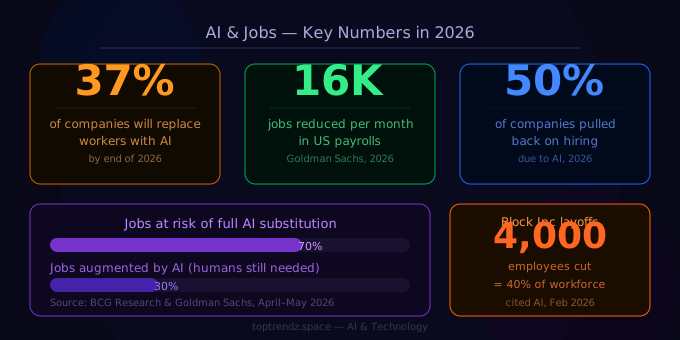
Economists from Goldman Sachs discovered that AI has shaved about 16,000 jobs from US employers' monthly payrolls over the past year.This sounds like bad news until you realize US employers collectively add hundreds of thousands of jobs each month. The net impact has been a 0.1 percentage point increase in unemployment.
In other words: real measurable but not yet disastrous.
The concern surrounding AI at the workplace is genuine—and not just anxieties about redundancy, but also the race to stay ahead in a quickly-changing technological landscape, " the tech giant wrote in a key report on workforce released this week.And they Definitely would. They have spent billions integrating AI into the same tools hundreds of millions of people are using every day.
The Part Nobody Talks About: AI Is Creating Jobs Too
This is what all the doom-and-gloom headlines keep overlooking. Looking at the same research on job losses, we also learn that Goldman Sachs finds that AI is actually creating jobs in some industries—where it helps people, by complementing their work instead of taking it over entirely.
Consider interior designers. AI can assemble mood boards, recommend color schemes, and produce 3D room layouts in a second. It cannot sit in a client's living room, understand the sentiment in what he or she is trying to achieve, and reflect that in a space that truly feels like home. The AI simply speeds up the designer.It does not render the designer obsolete.
This difference—between substitution and augmentation—is the single most important idea in the entire AI-jobs debate, and most authors on the subject have never even heard one of those words.
Also Read: ( Make Money with Ai in 2026 )
Jobs like a telephone operator, an insurance claims clerk, a bill collector belong definitely to the substitution category.Jobs such as an educator, a judge, a therapist, a construction foreman belong definitely to the augmentation category.
The first group has every reason to worry; the latter has every reason to learn to use new instruments.
What kind of jobs are really in danger today?
Given current data and the reality that layoffs are already taking place, the lines of work that are under the greatest immediate threat tend to have one characteristic in common: they are, or can be, broken down into well-defined, rules-driven tasks.
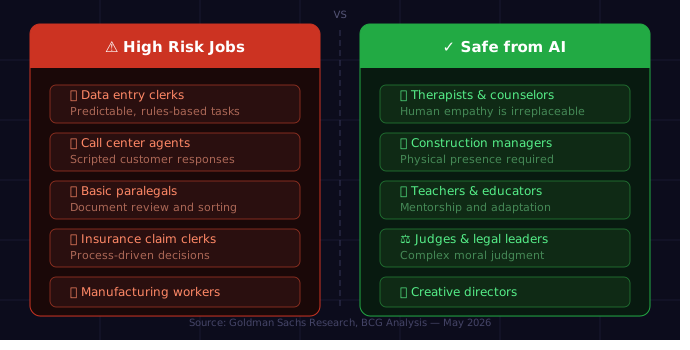
Job functions like data entry, simple customer service, content moderation, some paralegal work, starting-level programming tasks and routine financial analysis-anything that can be reduced to a set of rules and performed repeatedly-are the tasks here to be the first impacted. Not because AI is smarter than the actual people, but because AI is consistent with them, and consistency in high volume is incredibly valuable to companies concerned about cost.
A poll of 1,000 American business leaders indicate close to three in ten companies have already replaced jobs with AI and that by the end of 2026 it will be 37%.The poll also revealed that 50% of those same business leaders have already paused their hiring. If you occupy any of those positions and are reading along right now, you most likely felt like someone just dropped a punch to the gut while reading that last paragraph. You need to know this should not be simply blown off. That is a valid concern.
But Here Is What Nobody Can Automate
Spend five minutes with the state-of-the-art AI systems available today and you'll see one thing. They excel at fetching, summarizing and creating. They suck — often painfully so — at caring. They can't sit across the table from a grieving family and say all the right things.They can't scope out a conference room before a business negotiation. They can't coach a failing co-worker, realize that a patient looks a little under-the-weather despite having all normal tests, or make intuitive judgment calls that only time can teach.
Emotionally intelligent behavior, physical presence, creative risk-taking, ethical judgment, and authentic human relationships cannot be added to the next version of the software. They are human lives, living in a complex world.
The bottom line from BCG's new research is clear: automation does not cost jobs. The jobs stay the same—but they'll be totally different.The true survivors in five years time won't be the ones who've shunned AI. They will be those who knew how to turn it into a force-multiplier.
What Should You Actually Be Doing About This?
This is the section most articles skip, because dispensing useful advice is much more difficult than dishing out anxiety. So here it is in straight forward language.
First, be honest with yourself and audit your own role.List out all the things you do in an average week. Now, think about which of those items could be encapsulated as a well-defined, repeatable set of instructions that produce a desired output?Those are the processes AI will target. The remaining pieces, the judgements, relationships and creative problem solving are your differentiators.
Secondly, begin with mastering the tools, not battling them.Those workers who will be most threatened in five years are not the ones whose jobs can be performed by artificial intelligence. They are the ones who would not learn how to work with it.Growing comfortable using AI tools is becoming an expected skill, not a luxury.
Third, move toward irreplaceability. This may sound broad, but it isn't. Irreplaceable workers are at the intersection points—knowledge of people and technology, or data and strategy, or design and business results. The more you are leveraging judgment over bricks and mortar, the better.
The Honest Bottom Line
AI will not hit your job like a hurricane—quickly, indiscriminately, all in one fell swoop. It will hit your job in pieces incrementally by beginning with the cognitive tasks that resemble charting, scripting, and registering.
Those workers who do have a genuinely high exposure are those elsewhere—in jobs which Yes no matter how we want to sugar it, it always would have been somewhat of a letdown to start off with—because that was always what they were introduced to, what they did best.
The workers who will see 2026 as a crossroads—not a catastrophe but an inflection point—are those who took advantage of the year to ponder a more challenging one than "is my job at risk from AI?"
The harder question is: what do I do that a machine could never do?
Answer that, and you'll know exactly where to go from here.